Ask a multi-sport athlete to follow a standard strength program and you will quickly discover that the program was not designed for them. The off-season block assumes there is an off-season. The in-season maintenance phase is designed around a single season with a clear end date. The progressive overload schedule assumes a training calendar that is not competing with three practice sessions per week across two different sports, travel, and a full academic schedule. Standard strength programs are written for athletes with straight-forward schedules, and most multi-sport athletes are often underserved as a result.
What multi-sport athletes need is not a modified version of a single-sport program. They need a framework built around how they actually live: around overlapping seasons and limited recovery windows, around the transitions between sports that are their only genuine development windows, and around the understanding that the physical qualities most worth building are the ones that transfer across every sport they play. That framework exists. It just requires thinking about strength training differently than most programs do.
Why Standard Programs Fall Short
Traditional strength periodization is built on a relatively clear seasonal structure. An off-season where volume and intensity are high and development is the goal. A pre-season where training tapers as sport-specific preparation ramps up. An in-season plan that prioritizes maintenance. A post-season where recovery and reflection happen before the cycle begins again.
Multi-sport athletes compress, overlap, and collapse that structure in ways the model was not designed to handle. A soccer player whose fall season ends in November and whose basketball season begins in December has three weeks for what the standard model calls an off-season. A lacrosse player who is also a baseball pitcher may have those two sports running simultaneously in the spring with no division between them. A three-sport athlete who plays fall, winter, and spring may have a true off-season that lasts from mid-June to late August and nothing else remotely like it for the rest of the year.
Applying a standard program to that reality tends to produce one of two outcomes: either the athlete attempts to maintain full program adherence during peak overlap periods and accumulates fatigue that compromises both training quality and sport performance, or they drop structured strength training whenever their sport schedule gets demanding and restart from a diminished baseline each time there is room to train again. Neither outcome serves the athlete well.
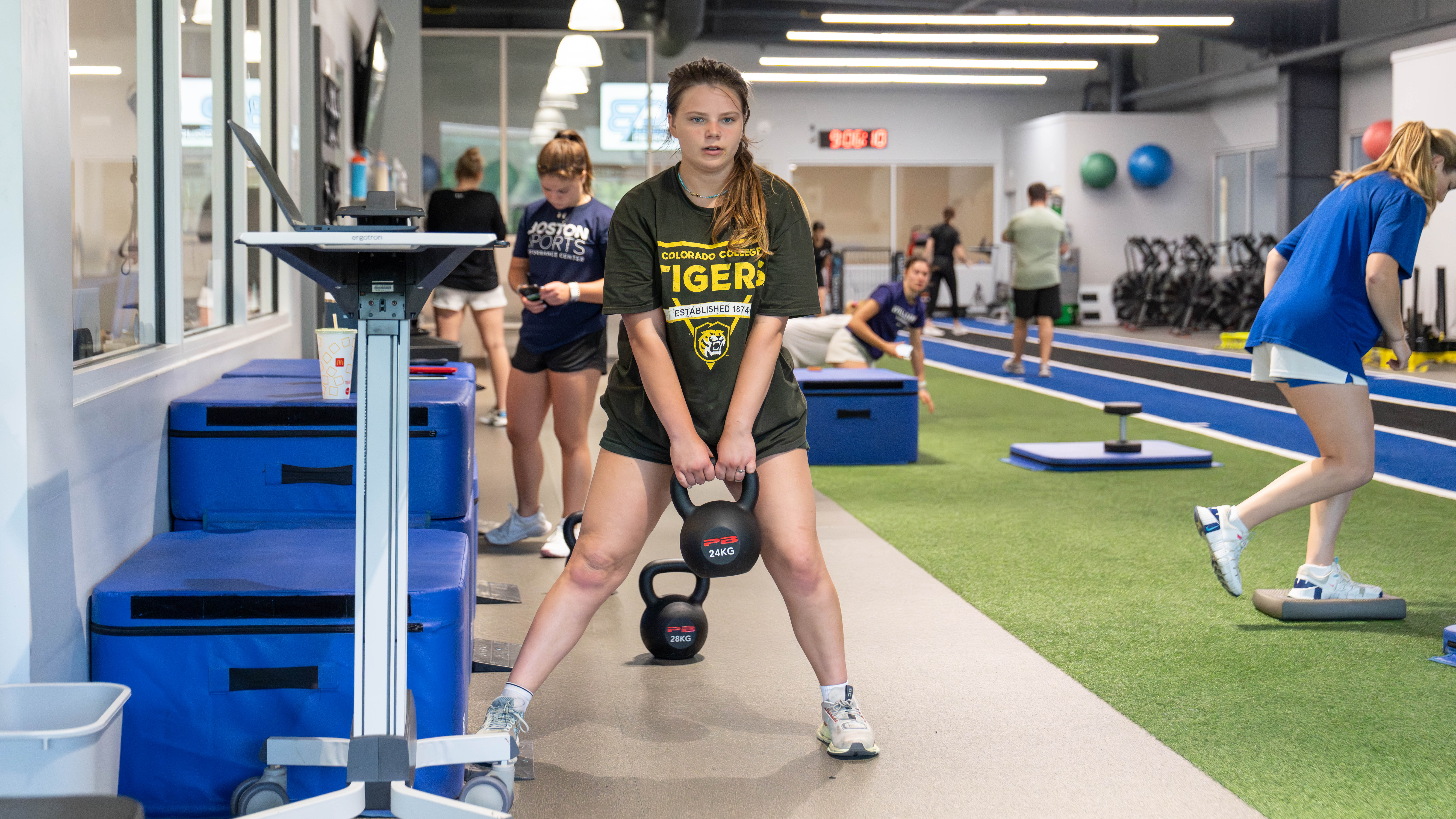
What Multi-Sport Athletes Actually Need
The physical qualities that make athletes better are not sport-specific. Strength, power, speed, stability, movement quality, and the resilience to sustain those qualities across a long competitive year are valuable in soccer, basketball, lacrosse, baseball, football, and every other season a multi-sport athlete might play in. A program that develops these general athletic qualities serves the athlete across everything they do, which is exactly why the weight room is worth the investment even when the schedule feels impossible.
What changes for multi-sport athletes is not what to train but how to structure training across a year that rarely offers the spacious seasonal windows a traditional program depends on. The framework that works is built around three principles: developing general athletic qualities rather than sport-specific ones, treating the transitions between sports as the primary development windows, and maintaining enough during active seasons to preserve what has been built rather than losing it and rebuilding repeatedly.
The Core Principle: Find the Seams
Every multi-sport athlete’s calendar has seams: the gaps between sports seasons where training load drops briefly and the body has the recovery capacity for more structured work. These windows are rarely longer than two to four weeks, and they are easy to miss if the athlete is not looking for them deliberately. They are also the most valuable training windows in the multi-sport calendar.
A two-to-three-week block between sports seasons, trained at three to four sessions per week with higher volume and developmental intent, produces meaningful strength gains when managed well. It is not as productive as a true eight-to-twelve-week off-season block, but it is substantially better than the alternative, which is maintaining at one to two sessions per week continuously without any developmental phase to drive adaptation forward.
Identifying these seams at the beginning of the year and planning around them in advance is one of the highest-leverage things a multi-sport athlete or their coach can do. A strength coach who sees the full competitive calendar can build transitions into the program deliberately rather than reacting to whatever the current week demands.
The Multi-Sport Strength Calendar
Rather than a fixed program, multi-sport athletes benefit from a flexible annual framework that adapts to their actual schedule. The structure looks something like this.
During an active sport season: maintenance focus, two sessions per week.
The goal is preserving the strength built during developmental windows without generating fatigue that compromises overall performances. Sessions are shorter, exercise selection is conservative, and total volume is kept low. The sport itself is providing the conditioning stimulus. Strength training during this phase keeps the body strong enough to handle that stimulus without wearing it down further.
Between sport seasons (two to four weeks): developmental focus, three to four sessions per week.
This is the multi-sport athlete’s primary development window, and it should be treated as one. Volume increases, intensity builds progressively, and the athlete prioritizes the foundational movements that carry over to every sport they play. If there is time to address specific weaknesses or imbalances identified during the previous season, this is when that work happens.
During peak overlap (two sports running simultaneously): survival focus, one quality session per week.
When practice schedules from two sports overlap and total training load is at its highest, the goal is simply not losing ground. One well-designed session per week maintains considerably more physical capacity than none, and it keeps the athlete in the habit of training without adding meaningful fatigue to an already demanding week. This is not the time for new exercises, high volume, or personal records. It is the time to stay consistent at a reduced level.
Summer (or the genuine off-season in an athlete’s schedule): full developmental block, three to four sessions per week.
For most high school multi-sport athletes, summer represents the longest genuine off-season window of the year. This is where the largest strength gains are possible and where foundational development should be prioritized most deliberately. A well-designed summer block of eight to ten weeks can produce meaningful improvements in strength, power, and general athletic capacity that carry through the entire competitive year that follows.
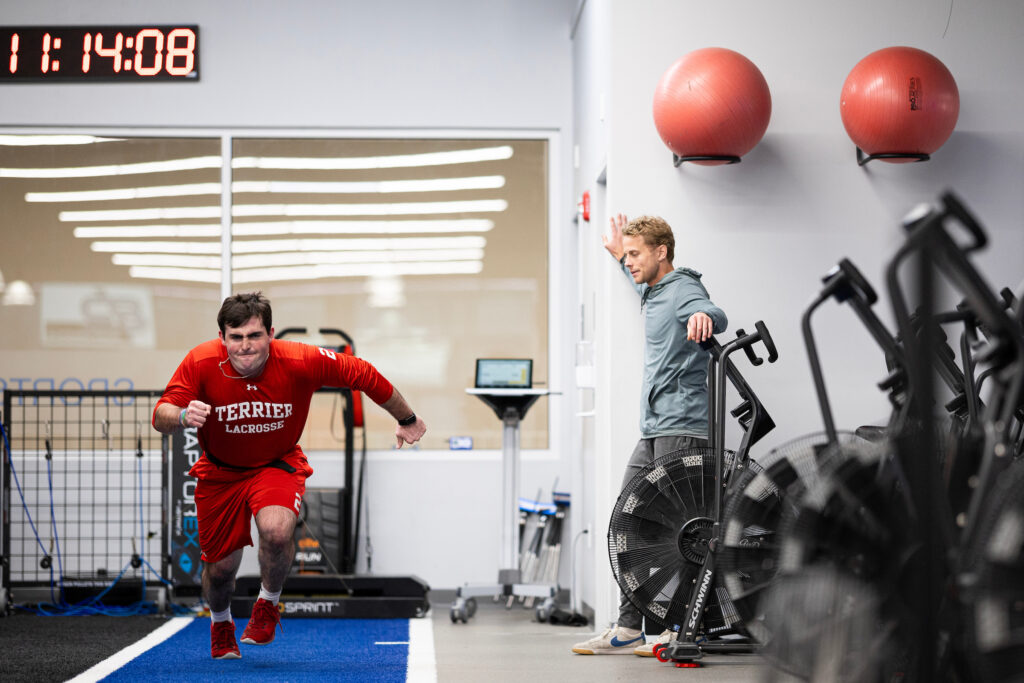
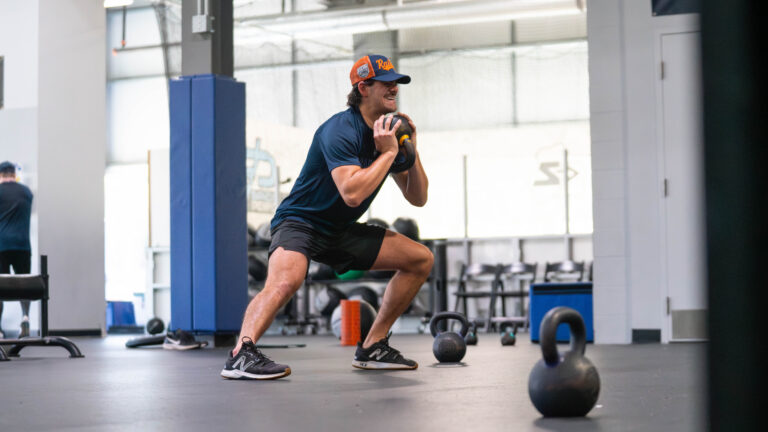
at Bando Performance, in Wellesley Massachusetts Friday, December 19, 2025.
(Photo by Eddie Monigan/Freelance)
What to Train: The Multi-Sport Exercise Foundation
Multi-sport athletes benefit most from strength work that develops broadly transferable athletic qualities rather than sport-specific movement patterns. A program centered on a small number of high-value compound movements is both more efficient and more durable across varying schedules than one built on extensive exercise variety.
The movements that belong at the center of a multi-sport strength program are familiar ones. Squat variations develop leg strength and the bilateral force production capacity that every sport draws on. Hip hinge variations, particularly deadlifts and Romanian deadlifts, build the posterior chain strength that drives acceleration, jumping, and athletic power output. Single-leg strength exercises, split squats and single-leg Romanian deadlifts most prominently, develop the unilateral stability and force production that field and court sports demand with every step. Push and pull movements in the upper body maintain the shoulder and scapular stability that reduces injury risk across a year of varied sport demands.
Core stability work is worth treating as a foundation rather than a finishing touch. The ability to transfer force efficiently through the trunk is relevant to sprinting, throwing, cutting, and jumping, which covers the primary movement demands of most sports.
What to deprioritize is equally important. High-volume isolation exercises that generate significant soreness without producing general athletic benefit, sport-specific technical movements better developed in practice itself, and anything that reliably compromises an athlete’s ability to practice and compete the following day. The weight room should be a tool in service of performance, not a competing priority.
Managing Fatigue Across Multiple Sports
Total training load is the variable that governs everything else in a multi-sport athlete’s program. Sport practice, games, travel, strength training, school, and the general demands of adolescent life all contribute to how much the body has available to give on any given day. A strength session that would be appropriate for an athlete in a controlled single-sport off-season may be excessive for an athlete who had two-a-days the previous week and a tournament the coming weekend.
This is where the value of working with a coach who sees the full picture becomes most apparent. A strength coach who knows only that an athlete is scheduled for three sessions per week cannot make the adjustments that the actual week requires. A coach who knows the schedule, who communicates with the coaches, and who monitors how the athlete is responding across the full training load can make those adjustments in real time.
There are a variety of warning signs of excessive load to know and look out for:
• Persistent fatigue that does not resolve after a normal rest day
• Declining sport performance despite consistent training
• Unusual soreness in areas unrelated to recent exercise
• Disrupted sleep
• Mood changes and reduced motivation that seem disproportionate to the training demands.
These signals are the body’s communication that recovery is not keeping pace with load, and they need a response rather than an simply being pushed through.
The Injury Prevention Case
Multi-sport athletes are exposed to the movement demands of multiple sports across the year, which creates a specific injury risk profile that single-sport athletes do not share. A basketball player working through the contact and cutting demands of a winter season who then starts pitching for the baseball team in the spring is transitioning stress and load to their upper body without much of a recovery window for their lower half. A soccer player who moves into indoor basketball and then spring lacrosse accumulates repetitive stress across the lower extremities from three different sports without the tissue recovery time that the body needs to adapt fully.
A strength program that develops general athletic balance, strong hips, stable joints, symmetrical force production, and resilient connective tissue, reduces the vulnerability that those competing demands create. This is one of the strongest arguments for maintaining consistent strength training throughout the multi-sport calendar rather than treating it as something to pick up when the schedule allows. The athletes who stay healthiest across a year of multi-sport participation are generally the ones whose physical foundation is strong enough to absorb the accumulated load.
FAQs
Can an athlete make strength gains while playing multiple sports?
Yes, though the gains happen primarily during the transitional windows between sports rather than during active seasons. Athletes who train consistently at a maintenance level during their sports seasons and shift to a developmental focus during transitions make meaningful progress across the full year, even without a traditional extended off-season. The key is consistency across all phases rather than intensity during any single one.
What if my coaches have conflicting expectations about training?
This is one of the most common challenges for multi-sport athletes. The most effective solution is a strength coach or performance professional who communicates directly with the individual team coaches about what the athlete is doing in the weight room and why, and who can explain how strength training supports rather than competes with sport performance. Most sport coaches, when given clear information about the programming rationale, are more flexible about training schedules than their initial expectations suggest.
How do I know when my athlete is doing too much?
The clearest signals are declining sport performance despite consistent training, persistent fatigue that does not resolve with normal rest, recurring soreness in areas unrelated to recent training, and behavioral changes like reduced motivation or disrupted sleep. Any one of these is worth paying attention to. Multiple at once is a clear signal to reduce load and prioritize recovery before adding anything back.
Should multi-sport athletes specialize as they get older?
Many do, particularly as the recruiting process begins to prioritize potential in a primary sport. The timing and manner of that transition matters. Athletes who specialize earlier tend to carry higher overuse injury rates. Those who maintain multi-sport participation through mid-adolescence and specialize later often arrive at their primary sport with a broader physical foundation that serves them well. When specialization does make sense, maintaining general strength training alongside sport-specific development remains important regardless of which sport becomes the primary focus.
Final Thoughts
Multi-sport athletes are not a problem to be solved with a modified program. They are a specific type of athlete with a specific set of constraints, and they require a strength program designed with those constraints as the focus rather than having it applied around the edges of a model that was not built for them.
The athletes who develop most consistently across a multi-sport career are the ones who find a way to train productively at every phase of the year, even when that training looks different from what any given week might ideally allow. The framework is simpler than it seems: develop general athletic qualities, protect the transitional windows, maintain during the busy stretches, and work with someone who can see the full picture.
If you are trying to build a strength program that actually fits a multi-sport athlete’s life, Bando Performance is designed to do exactly that.