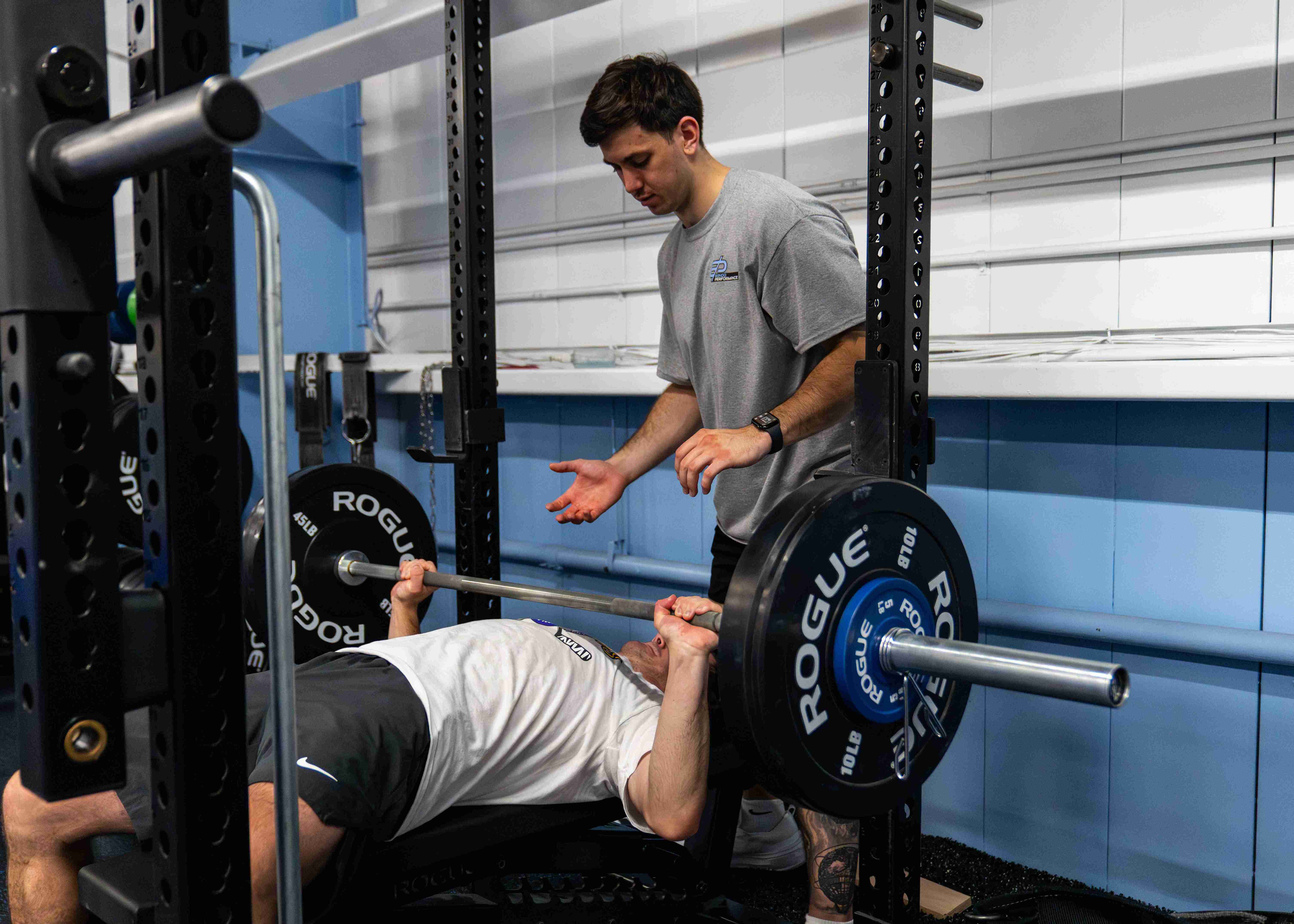
at Bando Performance, in Wellesley Massachusetts Friday, December 19, 2025.
(Photo by Eddie Monigan/Freelance)
Speed, in the athletic sense, is the ability to cover distance in minimum time. It is a product of force production, stride mechanics, and the neuromuscular coordination that allows the body to apply maximum force in the brief window of each ground contact. Faster athletes are not simply trying harder than slower ones. They are producing more force more efficiently, with better mechanics, and with shorter time on the ground per stride.
Conditioning is the ability to sustain physical output over time. A well-conditioned athlete can maintain effort deeper into a game, recover faster between plays, and perform at a higher level in the fourth quarter than a poorly conditioned one. Conditioning is a metabolic and psychological quality: it reflects the body’s capacity to manage fatigue, buffer the byproducts of sustained effort, and continue producing output when everything is telling it to slow down.
These are both genuinely important athletic qualities. The problem is not that one is more valuable than the other. The problem is that they are trained through different mechanisms, respond to different stimuli, and require different session structures to develop. When those session structures are mixed into the same activity, neither quality develops as effectively as it would if trained separately and deliberately. If you are wondering about the difference between speed training and conditioning, and how to isolate them respectively, you’ve come to the right place.
The Neurological Demand of Maximum Velocity Sprinting
Sprinting at true maximum intensity is among the most neurologically demanding things an athlete can do. The central nervous system must recruit near-maximal motor units with precise timing and coordination, sustain that recruitment across the full stride cycle, and repeat it at high frequency for the duration of the effort. This is not the same neurological demand as running at 70% of maximum effort for an extended period. It is categorically different, and it requires a nervous system that is not yet fatigued to execute it.
Fatigue degrades the neurological qualities that produce maximum sprint speed. As the central nervous system accumulates fatigue, motor unit recruitment drops, coordination becomes less precise, and the mechanical efficiency of each stride diminishes. An athlete who sprints in a fatigued state is not producing the same movement pattern as they do fresh. They are producing a slower, less coordinated approximation of it, and they are training the body to produce that approximation more efficiently. That is a real adaptation. It is just not the adaptation that produces increased speed.
This is the specificity of adaptation principle applied directly to speed development: the body adapts to the demands placed on it. Training at diminished intensity under fatigue produces adaptation to diminished intensity under fatigue. Training at true maximum intensity with full recovery produces adaptation to maximum intensity. Athletes who want to get faster need to spend time training at actual maximum effort, which requires the nervous system to be fresh enough to produce it.
Why Full Recovery Is Not Optional
The most counterintuitive aspect of genuine speed training for athletes accustomed to conditioning-heavy programs is how much rest it requires between reps. A true maximum velocity sprint effort of 20 to 40 meters requires somewhere between 90 seconds and three minutes of recovery before the next rep can be performed at the same quality. For shorter acceleration-focused efforts, the minimum is typically 60 to 90 seconds. These are not conservative estimates designed to make training comfortable. They are the recovery windows that allow the nervous system to regenerate enough to produce another maximum effort.
Sessions that compress those recovery windows are not speed sessions with shorter rest. They are conditioning sessions. The rest period is not incidental to the training. It is the mechanism that makes the training specific to speed development. Remove it, and the quality of each subsequent effort drops predictably until the athlete is running at a fraction of their maximum capacity and training the body to sustain that fraction, which is exactly what conditioning work is designed to do.
This is why genuine speed sessions often look underwhelming from the outside. An athlete completing six 30-meter sprints with two minutes of recovery between each one covers less total distance and spends far more time standing around than an athlete doing fifteen shuttle runs with 30 seconds of rest. While the shuttle run session looks more productive on the surface, the sprint session is more productive for speed development. Every rep is performed at true maximum intensity rather than at whatever intensity the athlete can sustain across fifteen accumulated reps.
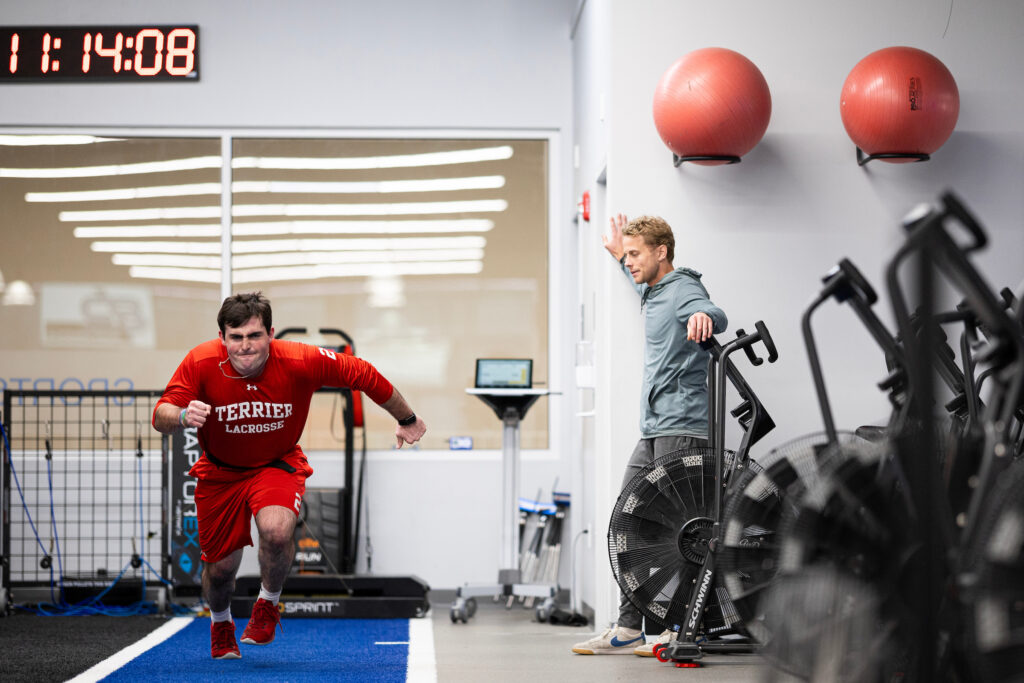
at Bando Performance, in Wellesley Massachusetts Friday, December 19, 2025.
(Photo by Eddie Monigan/Freelance)
The Honest Case for Conditioning
Acknowledging that fatigued sprint training does not develop maximum velocity is not to say it has no purpose. It has real and important value. It just develops different qualities than its advocates often claim.
Conditioning work, including shuttle runs, extended sprint sets, and repeated effort training, develops the metabolic capacity to sustain output across a full game. It trains the body to buffer fatigue byproducts more efficiently, to recover faster between plays, and to maintain effort when the physical and psychological cost of doing so is at its highest. These are genuine competitive advantages in virtually every team sport, and athletes who are better conditioned than their opponents have a meaningful edge in the late moments of a game where the outcome is often decided.
There is also a psychological quality that conditioning work develops: the willingness to produce effort when everything in the body is arguing against it. That quality has real value in competition, and the athletes who possess it tend to perform better under pressure than those who do not.
The argument is not that coaches who use fatigued sprint training are wrong to do so. The argument is that calling it speed training misleads athletes and parents about what is being developed, and that athletes who want to improve their sprint times need a different training stimulus than what conditioning work provides. Both qualities belong in a complete athletic development program. Neither belongs in the other’s session.
What a Speed Session Actually Looks Like
A session designed specifically to develop sprint speed has a different structure from what most youth athletes have experienced.
Speed work comes first in the session, before any meaningful fatigue has accumulated. The nervous system needs to be fresh, and there is no way to front-load recovery that has already been spent on warm-up conditioning or lifting. A thorough dynamic warm-up prepares the body for maximum effort without depleting the neurological resources required to produce it.
The reps are short and the quality standard is absolute. Efforts of 10 to 40 meters at true maximum intensity, with complete recovery between each one. If the athlete cannot produce a rep that feels like maximum effort, the session is over. More reps at diminished quality are conditioning, not speed development. Most quality speed sessions involve four to eight reps, sometimes fewer, depending on the distance and the athlete’s training stage.
What does not happen in a speed session is conditioning work designed to accumulate fatigue. If conditioning is also a training priority for that day, it belongs in a separate session or at the very end of the same session after speed work is complete and the training goal has been achieved. Mixing the two stimuli in the same block compromises development.
Why the Confusion Persists
Understanding why there is widespread confusion around the difference between speed training and conditioning makes it easier to address without simply blaming coaches or programs that perpetuate it.
Fatigue looks and feels like hard work, and hard work is a core value in team culture. A session that leaves athletes exhausted feels productive regardless of what it actually developed. A session that leaves athletes with energy to spare because each rep was short and fully recovered feels like it could have been harder, even if every rep was executed at true maximum intensity. Effort is visible and measurable. Neurological quality is not.
Many coaches came up in training environments where conditioning and speed training were treated as interchangeable, and they pass what they learned to their athletes in good faith. The methods were not wrong for what they were developing. They were mislabeled. And the mislabeling has compounded across generations of coaches and athletes who learned that running fast until you are tired is how you get faster.
The consequence is not that athletes from these programs are poorly coached. It is that they often arrive at the next level with excellent conditioning and underdeveloped maximum velocity, and they struggle to close the speed gap because they have spent their development years training a different quality.
Developing Both Qualities the Right Way
The practical takeaway from this distinction is not that conditioning work should be eliminated from athletic training. It is that both qualities deserve their own dedicated training stimulus, their own session structure, and their own recovery demands.
For athletes who want to get faster, speed sessions should be protected. Fresh nervous system, short efforts at true maximum intensity, full recovery between reps, and no conditioning work until the speed session is complete. Two to three dedicated speed sessions per week, structured this way, produce genuine improvement in sprint times that conditioning work alone rarely delivers.
Conditioning work belongs in its own sessions or its own blocks within a training week. Repeated effort training, interval runs, and the kind of metabolic conditioning that develops game fitness are valuable and worth training deliberately. They just belong in a different session than speed development, with a different structure and a different set of goals.
Athletes who train both qualities deliberately, with the structure appropriate to each, develop faster sprint times and better in-game fitness than those who mix the two into the same stimulus and get a diluted version of both.

FAQs
Can you train speed and conditioning in the same session?
Yes, but the order matters and the training cannot overlap. Speed work must come first, when the nervous system is fresh and maximum intensity is achievable. Conditioning work can follow after the speed session is complete. Reversing that order, or mixing the two into the same continuous block of work, tends to compromise the quality of the speed training without meaningful improvement to conditioning.
How do I know if a session is developing speed or conditioning?
The clearest indicator is recovery time. If the rest between efforts is long enough that each rep feels like maximum effort and the athlete is genuinely trying to run as fast as possible, it is speed work. If the rest is short enough that effort is sustained across many reps at a pace below maximum, it is conditioning. Both have value. Knowing which one you are doing is what allows you to train each appropriately.
Do gassers and shuttle runs improve speed?
They improve the ability to sustain repeated efforts across a game, which is a genuine and important athletic quality. They do not meaningfully improve maximum sprint velocity, because the training intensity and recovery structure required to develop maximum velocity are not present in extended shuttle run sets. Athletes who want faster 40-yard dash times or better first-step explosion need training that is specifically structured to develop those qualities.
How fast should I be running during speed training?
As fast as you can actually run on that rep, given full recovery from the previous one. The standard is maximum voluntary effort, not a percentage of some measured maximum. If a rep does not feel like a genuine maximum effort, either the recovery was insufficient or the session has reached its productive limit for that day. Adding more reps at diminished effort is conditioning from that point forward, not speed development.