Somewhere along the way, prehab became shorthand for a set of resistance bands and a mobility routine that athletes do for five minutes before lifting, mostly because someone told them it would keep them healthy. It has the sound of a serious idea and the structure of a warm-up, and that gap is why so many athletes do it faithfully and still end up in a physical therapist’s office.
The more useful way to think about prehab is as a decision about timing rather than a category of exercise. Prehab is targeted training aimed at a specific weakness or risk factor before it turns into an injury. Rehab is structured treatment and progressive loading that restores function after an injury has already happened. The tools overlap heavily, and the real difference is whether you start with a problem or with a prediction.
The Difference Is What You Know When You Start
Rehab begins with a diagnosis. Something hurts or has failed, a clinician identifies the structure involved, and the work is built around restoring what was lost: range of motion, strength, tolerance for load, and eventually the ability to perform. The starting point is a deficit, and the goal is a return to baseline and beyond.
Prehab begins with an assessment instead, and that changes what it asks of you. Nothing is broken, so the question becomes where your body is most likely to break given your sport, your history, and how you move. A sprinter with a previous hamstring strain, a pitcher with limited rotation on the throwing side, and a soccer player whose knee drifts inward on landing are carrying different risks, and an effective prehab plan looks different for each of them. It is the same logic as rehab applied earlier, with less certainty and more room to establish a development strategy.
Why Most Prehab Does Very Little
The usual failure is that prehab becomes maintenance for nothing in particular. Athletes repeat the same banded routine for months, the resistance never changes, and the work is too light to challenge the tissue it is supposed to protect. Muscles, tendons, and the nervous system adapt to load, which means an exercise that never gets harder stops doing anything once your body is accustomed to it.
Effective prehab borrows its structure from good rehab. It targets an identified weakness, it progresses over time, and it is loaded enough to matter. It also tends to work better inside your lifting program than bolted onto the front of it, because a hard set of a well-chosen, intentional exercise once or twice a week usually builds more than a gentle version performed daily as a ritual.
What Prehab Looks Like by Body Area
The right exercises depend on what an assessment finds, but a few have solid reasoning behind them for the areas that cause athletes the most trouble.
Hamstrings. Nordic hamstring curls build eccentric strength, which is the ability to control the muscle as it lengthens, and that lengthening phase is where high-speed strains tend to occur. Programs built around them have been associated with lower hamstring injury rates in running sports.
Knees and ankles. Single-leg work like lateral step-downs and single-leg Romanian deadlifts challenges the stability these joints rely on, and landing drills teach you to absorb force with the hips, knees, and ankles stacked. Neuromuscular training of this kind has been associated with fewer non-contact knee injuries.
Shoulders. For throwing and overhead athletes, banded external rotation and prone Y-T-W raises strengthen the rotator cuff and the muscles that stabilize the shoulder blade, both of which share the load when the arm accelerates.
Hips and groin. Copenhagen planks strengthen the adductors, a group that field and court athletes often neglect and that tends to be involved when groin strains occur.
Achilles and calves. Slow, heavy calf raises build the tendon’s capacity to tolerate load, which matters most if your sport has you running and jumping in high volume.

When Prehab Needs to Become Rehab
Prehab has an exit ramp, and athletes miss it more often than they should. If pain is localized to a joint or tendon, shows up in the same place at the same point in training, or starts to change how you move, you are no longer preventing an injury. Continuing to prehab around it delays an evaluation you need, and training through it can turn a manageable problem into a longer one. A week of persistent, specific pain is a reasonable point to get assessed rather than a reason to push on.
The reverse matters too. Once rehab ends and you are cleared, the work that got you there should flow back into your training as prehab, since the injured area is now a known risk. That handoff is where many athletes stop doing anything at all, and it is a large part of why rehab shouldn’t end when the pain goes away.
A Quick Test of Your Current Routine
Three questions will tell you most of what you need to know. Can you name the specific weakness or risk each exercise is meant to address? Has the load, the difficulty, or the variation changed in the past six weeks? Does the work ever leave the target muscle genuinely fatigued, or could you do it half asleep? If the answers are no, no, and no, you are probably doing a warm-up and calling it prehab, which is better than nothing but is unlikely to change your injury risk in any meaningful way. One yes is a start. Three is what a real prehab plan looks like.
Where an Assessment Fits
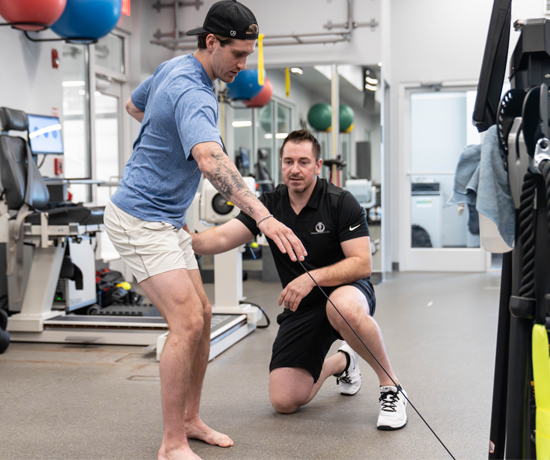
The most practical first step is a movement assessment, because it replaces guessing with information about what risks actually apply to you. From there, a plan usually takes 10 to 15 minutes, two or three times a week, built into sessions you already do. At Bando Performance in, physical therapists and performance coaches work from the same assessment, so the prehab you do is written into your training instead of layered on top of it. If you are not sure whether what you are doing counts as prehab or is just a warm-up with extra steps, an assessment is the fastest way to find out.